
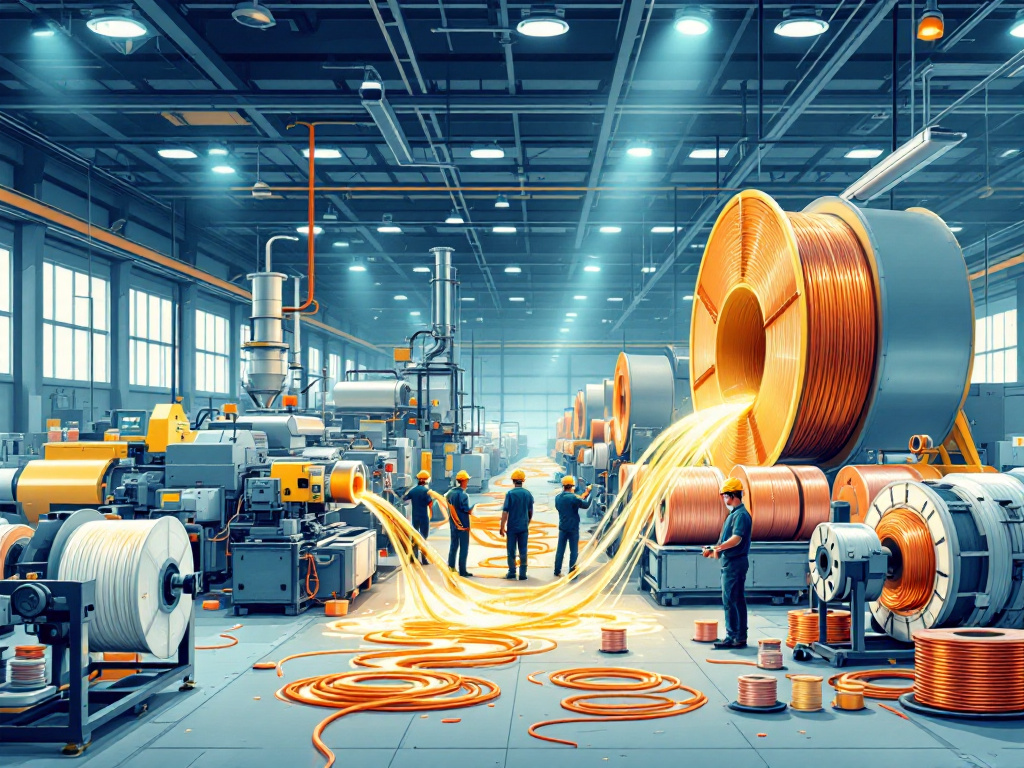
Advanced Technologies Used by Cable Manufacturers in Australia
Shared cables worldwide manufacturing industries have significantly revolutionized their technologies over the past ten years to meet the constantly increasing demand for products with higher performance, longer lifetimes, greater efficiency, and environmental friendliness. The cable manufacturing industry in Australia, although much smaller in comparison with the global giants, has been one of the first to embrace advanced technologies whose main purpose is not only to raise product quality but also to assist the producer in meeting various strict safety and environmental regulations.
Technologies such as automation and robotics, digital twins, and advanced materials science, among others, used by the Cable Manufacturer in Australia, demonstrate a mixture of innovation, practicality, and preparedness for the future. This blog delves into the main cutting-edge technologies that are currently revolutionizing the cable manufacturing industry in Australia.
1. Automation & Robotics: Precision at Scale
Among the changes that have most significantly affected the cable manufacturing industry in Australia is the rapid implementation of automation and robotics. The manual activities, usually related to cable production, are being substituted by extremely accurate automated systems that are capable of:
Precise extrusion of conductors and insulation layers
Cable geometry that is consistent in cross-sectional area
Automated cutting, coiling, and packaging
Benefits:
Production errors have been drastically reduced
The flow of production has been greatly standardized
Processes that require manual labor have been reduced
There is better safety when carrying out hazardous tasks
Presently, robotic arms are used for spool loading/unloading, cable strand twisting, and even quality inspection, all this happening in real time and without human intervention.
Example: An Australian manufacturer of a middle scale upgraded its conductor straightening and insulation application lines with robotic systems that helped them cut defects by 40% and speed up production by 25% within one year.
2. Digital Twin Technology: Virtual Testing and Optimization
A digital twin represents a physical system virtually - here, a manufacturing line for cables. Cable manufacturers in Australia use digital twins to:
Test their lines' efficiency under different conditions by way of simulation
Identify potential hindrances during production before they really happen
Discover the configurations that yield the highest speed, least material wastage, and best quality
Perform "what-if" analyses so as to reduce downtime
How It Works:
The digital twin software receives data from various sensors on the factory floor. Thus, the virtual model tracks real-time operations and shows what points of operations are likely to become bottlenecks or quality issues.
Advantages:
Quicker troubleshooting and issue solving
Lower level of unplanned downtime
Better predictive maintenance
Improved resource allocation along with energy saving
The application of digital twin technology is highly justified for complicated cable types like fibre optics or specialty industrial cables, where it is essential to be very precise and maintain consistency.
3. Industry 4.0 & IoT Integration: Connected Manufacturing
Moving towards Industry 4.0 is not only about installing automation but also about setting a networked environment among machines, sensors, and software systems. To this end, the Australian cable manufacturers are adopting heavily:
IoT-enabled sensors that are attached to production equipment
Cloud platforms for the purposes of data analysis and report generation
Edge computing that provides real-time decision-making support
Machine-to-machine communication
Such connectivity allows for providing live data on performance - such as temperature, tension, speed, and material usage - which can be used to detect deviations instantaneously.
Real-World Impact:
Identification of insulation thickness variation at the initial stage
Specification maintenance through the implementation of automatic adjustment
Reduction of waste and power consumption
Benchmarking of performance across plants
Along with IoT and Industry 4.0 systems, manufacturers enhance both their efficiency in operations and the quality of their products.
4. Advanced Materials & Nanotechnology
The quality of cables is mainly determined by the types of materials used. Australian manufacturers are presently investigating the use of upgraded polymer compounds, nano-filled materials, and high-temperature-resistant insulation to produce cables that can be certified for meeting the most demanding criteria, such as
Being able to operate under higher temperatures
Higher electrical conductivity
Getting more resistant to fire
Less releasing harmful substances into environment
Nanotechnology:
Using nanomaterials such as graphene or nano-silica improves the physical and electrical properties of the product. As examples:
Nanocomposite insulation will give better thermal and dielectric qualities
Nanofillers make it possible to diminish the effect of oxidation; thus, a cable will last longer.
Sustainability Aspect:
Newly developed biopolymers and recyclable sheath materials not only work better but also use fewer raw materials. This is therefore a good fit with Australia's sustainability goals.
5. High-Precision Extrusion & Laser Calibration
Extrusion in cable manufacturing is the step where the insulation and jacketing of cables are formed. This is one of the most crucial steps in the making of cables. High-precision extrusion systems with laser calibration and feedback loops are being adopted by Australian plants for:
achieving micron-level uniformity of thickness
lightening the amount of raw materials getting wasted
enhancing the electrical properties
How Laser Calibration Helps:
The laser measuring instruments monitor the diameter and shape of the cable round the clock during the manufacturing process. Whenever the cables are deviating from the standard, the extrusion machine cuts back or alters its speed or die settings automatically.
This equipment is of great help when producing cables for IT, aerospace, and crucial infrastructure, where the focus on measurements must be extremely precise.
6. Non-Destructive Testing (NDT) & AI-Powered Inspection
Assuring top quality is a must for cable production, especially when it comes to high-voltage, industrial, or communication cables. Instead of relying solely on the traditional sampling methods, nondestructive testing (NDT) along with AI-based optical inspection is being used nowadays.
Some of the Main Tools Are:
Scanning of internal faults by infrared imaging
Conductor and insulation quality are probed via X-ray
Machine vision with high-res cameras
AI enabling the detection of irregularities in vivo
Advantages:
Entire production line is checked rather than a small sample
Defects can be detected and fixed well before shipment
Reduction in product returns and warranty claims
Industry and safety standards are met more closely
Inspection technologies using AI are trained on past records and enhance their performance gradually and thus they can identify even the most minute flaws invisible to humans.
7. Additive Manufacturing (3D Printing) for Prototyping
Although generally not accepted as a standard mass production method for cable manufacturing, Australian manufacturers have been using additive manufacturing (3D printing) extensively for:
fast prototyping of tooling and fixtures
custom connector designs
making intricate moulds for speciality cable assemblies
cable types new small batch or experimental run
This way, the lead time and the cost involved in bringing a new product to the market are brought down dramatically; hence, companies can quickly come up with an innovative solution to the changing market demands.
Conclusion: Australian Cable Manufacturing Is Ready for the Future
Cable manufacturing in Australia has not only grown and developed the traditional ways of production but also turned into a tech sector that largely focuses on accuracy, environment-friendliness, and innovation. From the use of robotics and Industry 4.0 integration to the employment of digital twins, AI-based inspection, and cutting-edge materials science, manufacturers are bringing more efficiency to their processes with the help of these modern tools, and at the same time, They are positioning Australian cable products as a globally competitive brand.
Be it for energy transmission, telecom, industrial automation, or any other specialized infrastructure projects, the technologies that have been discussed - automation, IoT, digital simulation, high-precision extrusion, and sustainability monitoring - together they stand as a signature of the evolution of cable manufacturing in Australia.
These breakthroughs will serve to increase production capabilities and at the same time, they will be instrumental in leading the industry towards growth, job creation, and Australia's overall technological progress.
Also Read: Fire-Rated Cables Explained: Standards, Features & Applications






0 Comments