
Hybrid Cloud Colocation: Supporting Flexible and Resilient IT Infrastructure
The way organizations design and manage IT infrastructure has changed significantly in recent years. Businesses now need systems that can handle fluctuating workloads, protect sensitive data, and support continuous digital operations. While traditional on-premises infrastructure offers control, it often lacks scalability. On the other hand, relying entirely on public cloud services can create concerns around data governance, performance consistency, and long-term costs. This has made hybrid cloud colocation an increasingly preferred approach for modern enterprises.
Understanding Hybrid Cloud Colocation
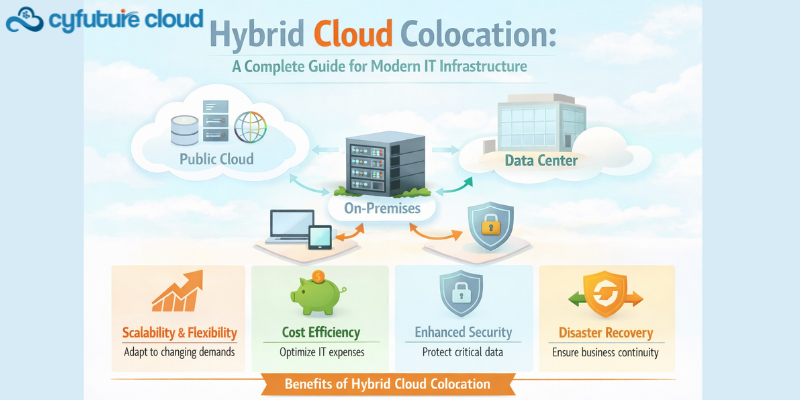
Hybrid cloud colocation is an infrastructure model where businesses place their physical servers in a third-party colocation data center while also integrating public or private cloud services. The colocation provider supplies the secure facility, power, cooling, and connectivity, while the organization manages its own hardware and applications. This arrangement enables companies to combine dedicated infrastructure with cloud flexibility in a single, connected environment.
With hybrid cloud colocation, organizations can decide which workloads remain on private servers and which move to the cloud, based on performance needs, compliance requirements, or cost considerations.
Why Organizations Are Choosing Hybrid Cloud Colocation
The growing adoption of hybrid cloud colocation is driven by practical operational benefits.
1. Greater Infrastructure Flexibility
Hybrid environments allow businesses to run stable, long-term workloads on private infrastructure while using cloud platforms for development, testing, analytics, or temporary capacity needs.
2. Better Cost Management
Colocation reduces capital investment by eliminating the need to build and maintain an in-house data center. Hybrid cloud strategies also help manage operational expenses by avoiding unnecessary cloud consumption for predictable workloads.
3. Improved Security and Compliance
Sensitive data can be stored on private servers within secure colocation facilities, helping organizations meet industry regulations and data residency requirements while still connecting to cloud services.
4. High Availability and Performance
Colocation data centers are built with redundant power, cooling, and network systems. When combined with direct cloud connectivity, this ensures consistent performance and minimal downtime.
Key Components of a Hybrid Cloud Colocation Setup
A successful hybrid cloud colocation environment depends on several core elements:
Enterprise-Grade Colocation Facility with physical security, redundancy, and environmental controls
Reliable Network Connectivity to public cloud platforms and business locations
Integrated Management Tools for monitoring workloads across on-premises and cloud environments
Scalable Infrastructure that supports future growth and changing business requirements
These components work together to create a unified infrastructure that supports both operational stability and digital growth.
Use Cases Across Different Industries
Hybrid cloud colocation is suitable for a wide range of industries:
Enterprises use it to modernize legacy systems while transitioning to cloud-based architectures.
Financial institutions depend on it to meet compliance standards while benefiting from cloud-based analytics and automation.
E-commerce and SaaS companies rely on hybrid models to handle traffic spikes and seasonal demand efficiently.
Healthcare and education organizations protect sensitive data while enabling remote access and digital services.
These use cases highlight the adaptability of hybrid cloud colocation to different business and regulatory needs.
Business Benefits Beyond Infrastructure
Beyond technical advantages, hybrid cloud colocation provides strategic business value. It improves disaster recovery by enabling data replication across environments and supports business continuity during unexpected disruptions. Organizations also gain the agility to deploy new applications faster without major infrastructure changes.
This model also prepares businesses for future technologies such as artificial intelligence, machine learning, and edge computing. Hybrid environments make it easier to adopt these innovations while maintaining control over critical systems.
Factors to Consider When Choosing a Colocation Partner
Selecting the right colocation provider is essential for long-term success. Businesses should assess facility uptime, security standards, connectivity options, scalability, and support services. A reliable provider ensures infrastructure stability while allowing organizations to focus on core business objectives.
Geographic location is another important factor. Proximity to users and regional markets can significantly affect application performance and latency.
The Importance of Colocation Jaipur in Hybrid Deployments
As organizations look beyond major metro hubs, regional data center facilities are gaining attention. Colocation Jaipur is emerging as a viable option for extending hybrid cloud colocation strategies into growing business regions. With improving network connectivity, cost advantages, and increased demand for localized data hosting, Colocation Jaipur supports businesses seeking dependable infrastructure while maintaining seamless integration with cloud platforms.
By combining private infrastructure control, cloud scalability, and professionally managed facilities, hybrid cloud colocation continues to support flexible, secure, and resilient IT environments for modern organizations.





0 Comments